Sunday, May 2, 2010

Najib is afraid to lose Sibu seat


SIBU: Prime Minister Najib Tun Razak today reminded the Barisan Nasional machinery to regard the Sibu parliamentary seat by-election as a challenge that should be taken seriously.

He said in the spirit of solidarity in BN and in Sarawak, the BN machinery would run smoothly to ensure victory in retaining the seat.

"We may be facing a stiff contest, so we need to focus on our campaign efforts," he said after attending a luncheon and presenting the Pingat Jasa Malaysia (PJM) medals to 32 state veterans of the Malaysian Armed Forces at the Rascom Camp, 9th Infantry Brigade, Jalan Ulu Koya, near here.

Also present were Chief Minister Abdul Taib Mahmud, Defence Minister Ahmad Zahid Hamidi, Energy, Green Technology and Water Minister Peter Chin, Army chief General Ismail Jamaluddin and BN candidate for the Sibu by-election, Robert Lau Hoi Yew.

Asked on BN's chances of retaining the seat, Najib said BN would work hard towards that with the cooperation of all its component parties.

On his working visit and his walkabout in several areas here including Sungei Merah town, he said the local residents' reaction was encouraging.

He said he was also happy with the development projects being carried out or in the process of being implemented like the flood-mitigation project in Kampung Nangka.

The prime minister said from the walkabouts, he also received feedback on the needs of the local communities.

Earlier, he said an allocation would be approved to repair and renovate the surau and religious school at the Rascom Camp.

Among the recipients of the PJM medal today was Temenggong Kanang Langkau, 67, from Sri Aman, and also the first Malaysian to receive the Seri Pahlawan Gagah Perkasa (SP) and Panglima Gagah Berani (PGB) medals for gallantry.

Saturday, April 17, 2010

Where is the commitment to 1Malaysia?


APRIL 17 — Datuk Seri Najib Razak has a real talent in delivering speeches, and sounds every part the statesman, especially on his travels around the world.

Closer to home, half of his countrymen are disgusted with the actions and words of some of his Umno party colleagues and Perkasa — the right-wing Malay group that is not quite Umno but whose members are mostly drawn from Malaysia’s biggest political party.

Speaking in New York yesterday, Najib said a multi-ethnic Malaysia must work towards forging a genuine national identity and that he stands ready to make difficult decisions needed by the country.

In one of his strongest speeches on his 1 Malaysia agenda, delivered at the Asia Society in New York, the prime minister acknowledged that there would be entrenched opposition but he was determined to deliver the reforms to bring the people together and place the country on the path of a high-income economy.

To his detractors, he had this to say:

“To those who harbour doubts about whether as prime minister and the government including my other colleagues have the will to bring about these difficult changes, I have this to say: When the going gets tough, the tough get going.

“I am ready to make the difficult decisions that Malaysia needs.”

Are you Mr Prime Minister?

Perhaps Najib should speak with the same kind of candour to his partymen and follow up with some action.

A good starting point would be to show that he is not cowed by Perkasa and right-wing politicians in Umno.

Most people who know Najib will defend him and point out that he is not a hypocrite, that he genuinely believes in his 1 Malaysia message.

But so far, aside from making the right noise, Najib has lacked the courage to actually even once tell off some of his Umno colleagues for putting his administration at risk of becoming an all-talk, no-action government.

Malaysians could see that Najib was willing to throw out his own 1 Malaysia philosophy to defend Tan Sri Muhyiddin Yassin, his deputy prime minister and Umno deputy president, for saying he was Malay first before he was Malaysian first.

Muhyiddin was perhaps reaching out to the conservative front of Umno and to the rural heartland personified by jingoistic and often downright scary editorials in Utusan Malaysia.

Perhaps the party No. 2, who according to his friends is also a great believer in multi-racialism and a true moderate at heart, is reaching out directly to the members of Umno who are keeping him in power.

But to ordinary Malaysians, this is a government that has not yet paid more than lip service to 1 Malaysia.

Democracy is about more than rule by majority.

It is also about the majority ensuring there is a place in the sun for all, particularly those in the minority.

The government’s proposed inter-faith panel is a case in point.

Before it has even started, it has now been torn to shreds by the religious conservatives and the right-wing in Umno.

Malaysians are being told almost on a daily basis that the majority will not accept it.

It is unclear if that is really true — that the majority of Malaysians will not accept the inter-faith panel unless its name is changed.

But what seems clear is that no one seemed to be bothered with asking how some minorities felt about the whole thing.
-TheMalaysiaInsider

Wednesday, April 14, 2010

Obama questioned Najib on his New Economic Model


Obama brings up topic of New Economic Model with Najib
By LIM AI LEE

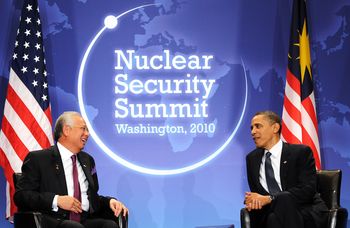
WASHINGTON: Malaysia’s New Economic Model (NEM) was one of the issues discussed during the bilateral meeting between Datuk Seri Najib Tun Razak and US President Barack Obama.

Obama, who raised the topic, wanted to know more about the NEM’s implementation.

The Prime Minister said he informed Obama of the Government’s goal of transforming Malaysia into a high-income economy and its liberalising policy.

“I explained that although Malaysia has been successful in its development approach in the past, it does not mean we will continue to be successful unless we look at a package that is more in tune with the new environment and can spur further development,” Najib said at a briefing for Malaysian journalists on Monday night.

Najib added that he brought up the example of Coca Cola investing RM1bil to illustrate how Malaysia had managed to convince huge American firms to invest in the country.

On his meeting with Obama that was held on the sidelines of the Nuclear Security Summit, Najib was optimistic it would pave the way for “a new beginning” that could lead to a broad, multi-faceted development.

“Economic and trade investment will be a key component of our bilateral ties as we move forward because the US is a big source, not only in terms of an export market for our manufacturing industry but also a source for new technology such as ICT and biotechnology.”

He pointed out that most fund managers and venture capitalists were US-based.

“There are thus a host of economic opportunities that we can leverage on if we have good bilateral ties with the US,” Najib said.

He also stressed on collaboration in terms of security, counter-terrorism and sharing of information under bilateral ties, saying:

“Equally important to us is making the world a safer place.”

Najib said he extended an invitation to Obama to visit Malaysia, adding that the last president to step into the country did so in 1966.

Apart from meeting Obama, Najib also attended a working lunch with US vice-president Joe Biden and later had a face-to-face meeting with New Zealand Prime Minister John Key.

Friday, April 9, 2010

Najib Razak has defended his New Economic Model


Malaysian PM Najib defends country's New Economic Model
By Imelda Saad
SINGAPORE: Malaysian Prime Minister Najib Razak has defended the country's New Economic Model which he revealed last week.

The plan, aimed at steering Malaysia to a high-income based economy, has received criticisms among some sectors for eroding its decades-old affirmative action policy.

Mr Najib was addressing more than 100 journalists at a dialogue session after his speech at a gala dinner organised by the Foreign Correspondents Association in Singapore on Tuesday.

The Malaysian PM arrived in Singapore just three days after marking his first year in office.

Fresh from announcing the country's new growth strategies, he explained the thinking behind some of the reforms.

Questions flowed fast on whether the New Economic Model will get a backlash from Malaysia's bumiputras and even within the ruling Barisan Nasional party.

Mr Najib said Malaysia's affirmative action policy, which gives Malays special privileges, have not hampered Malaysia's growth.

He said that even at the height of the New Economic Policy, Malaysia was growing at 8 to 9 per cent and some of the richest people in Malaysia are non-Malays.

Mr Najib said: "So it will be a more transparent and fairer way in which we implement affirmative action, and at the end of the day, I hope it will lead to a more cohesive and socially harmonious society."

He said the new approach to Malaysia's affirmative action is for it to be more "market-friendly, transparent, merit-based, and needs-based".

The reforms come after the Barisan Nasional took a knocking at the last general elections in 2008.

The results prompted the new prime minister to think about getting back to basics.

Mr Najib said: "What the public wanted and the rakyat or the people wanted was a change. But they did not want an incremental change or incremental changes, they wanted a massive transformation both economically and politically, and the time was right for us to embark on this."

He also revealed that Malaysia will identify new growth engines to propel the economy.

He did not give details, but said it will move beyond traditional sectors like oil and gas, rubber, and palm oil.

Mr Najib also said Malaysia will most probably issue Islamic bonds denominated in US dollars.

He did not reveal when this will take place or the size, which he said will be announced later. He said Malaysia does not actually need the money, but a bond issue would be a benchmark on how the markets viewed the country's creditworthiness.

He was asked about the possibility of a re-merger with Singapore.

Mr Najib said: "Both countries have taken different paths. It would be too traumatic to try to have a political reunification, but I would like to see deeper economic relations between Malaysia and Singapore, I would like to see good relations between both countries. I would like to see us work together in many fronts."

One is a joint project with Raffles Education to develop a university in Iskandar Malaysia, Johor's economic corridor.

The university will be implemented in three phases, with an initial enrolment of about 5,000 students within its first five years. Mr Najib said an application has already been made to Malaysia's Ministry of Higher Education to establish the university.

There is also a plan to build a Wellness Centre on a 500-acre plot of land in the area.

Mr Najib noted: "But we have not concluded it yet. So, that is a subject of intense discussion with Singapore."

Mr Najib and Singapore's Prime Minister Lee Hsien Loong are expected to meet for a retreat in Singapore next month to discuss how to further strengthen bilateral relations.

Now that the foundation has been set, all eyes will be on the implementation of the policies announced.

Mr Najib has indicated that details on the New Economic Model will be revealed over the next few months. - CNA/m

Najib to confront Malay extremism with confidence


MALAYSIAN Prime Minister Najib Razak said yesterday that he is confident he can deal with the backlash expected from his plan to dismantle the country's affirmative action, which favours Malays.

He admitted he is putting himself 'on the line' in Umno by rolling back pro-Malay initiatives.

But he said he senses that Malaysians were buying into the New Economic Model (NEM) and other policies unveiled by his administration.

Datuk Seri Najib was speaking at a gala dinner organised by the Foreign Correspondents Association of Singapore at the Fullerton Hotel. He later fielded questions for about an hour.

In his speech, he outlined his 1Malaysia concept and the Government Transformation Programme to improve the civil service.

He also spoke of National Key Result Areas the government wants to focus on, such as reducing crime.

Mahathir criticises Najib economic reforms


by Razak Ahmad
KUALA LUMPUR (Reuters) - Malaysia's influential former premier Mahathir Mohamad said on Wednesday the country's current prime minister had yet to live up to promises, and urged him to forge ahead with pledged reforms.

A vocal government critic who led the push to oust his immediate successor and usher in Najib Razak as premier in 2009, Mahathir also defended an affirmative action policy that favours the country's Malay majority. Najib has pledged to roll back Malay privileges in a new economic model he released on Tuesday.

"One year is not enough (for an assessment), you are just learning to be a prime minister really," Mahathir, 84, said in an interview on the sidelines of an investor conference.

"Najib has just released his economic policy, we need to see whether the performance is as good as promised."

Najib took office in April last year pledging reforms to rejuvenate investment and reverse 2008 election losses suffered by the coalition that has ruled Malaysia for 52 years.

But his government has delayed the introduction of petrol and electricity price rises, road toll increases and a goods and services tax in a series of decisions that has undermined market confidence in his ability to deliver economic reforms.

That, Mahathir said, was no way to oversee change.

"I think that is a very bad way of doing things," he said. "You make a decision, then you have to implement it, but before making a decision, you should think very carefully about it."

Friday, April 2, 2010

Najib approval rating climbs to 68pc


The Malaysian Insider, 2 April 2010

Datuk Seri Najib Razak is in a stronger position today than he was 12 months ago, when he was appointed Malaysia’s sixth prime minister, a recent survey has shown.

Then, his approval rating was a dismal 44 per cent; the economy was slipping into unforgiving negative territory, and he seemed vulnerable as he was pelted by bad news everywhere he turned.

Today, the proportion of Malaysians satisfied with his performance as the PM stands at 68 per cent, the highest it has been since the Merdeka Center for Opinion Research began tracking his approval ratings in April 2009, the month he replaced Tun Abdullah Ahmad Badawi in Putrajaya.

Merdeka Center polled 883 registered voters in West Malaysia between March 11 and March 27, and the questions covered the direction of the country, public satisfaction with the prime minister, and perception of some of his key initiatives.

A summary of the survey was obtained by The Malaysian Insider.

The pollster noted that, since June 2009, satisfaction levels with Najib’s performance as premier has hovered in the 65 per cent range, plummeting sharply once to 56 per cent in September last year, in the wake of the cow head protest by mainly Umno members against the construction of a Hindu temple in Shah Alam and the death of DAP aide, Teoh Beng Hock, while in the custody of the Malaysian Anti-Corruption Commission (MACC).

In the latest survey, 68 per cent of the respondents said that they were satisfied with the prime minister’s performance. This upward trend occurred despite issues that erupted recently, such as the “Allah” controversy and subsequent attacks on places of worship.

Najib’s improved numbers is also the result of a recuperating economy, along with an opposition which has been troubled by defections and infighting.

Saturday, March 20, 2010

Najib Asks For Press Support


By Syed Jaymal Zahiid
KUALA LUMPUR, March 19 — While insisting that the government respects press freedom, Prime Minister Datuk Seri Najib Razak (picture) has called on the media to “become his partner” and back the agenda of his administration.

Najib said tonight it was important that the media act as an educational tool to advocate “change” instead of inducing fear against it.

The media, said Najib, should play a vital role in his administration’s effort to end the subsidy mentality, nestled among the Malays which form the country’s majority and who are becoming more unsettled by the liberalisation efforts of Najib’s New Economic Model.

Referring to his government’s plan to cut away sugar subsidy and the outrage it sparked, the PM said it was the responsibility of the press to translate the move as positive for the good of the voters and the economy.

“Because of the high level of sugar consumption, the story must be skewed to inform the public even though the price of the commodity has gone up, it is not good because we take too much sugar,” said Najib in his speech at the National Press Club awards here.

Najib also denied the allegations that freedom of the press is curtailed, calling it an unfair description of the government-linked Malaysian mainstream media.

“I do feel at times that the accusations that Malaysia lacks press freedom is grossly unfair,” he said.

The country’s sixth premier maintained, just as his more authoritative predecessors had in the past, that “as long as the reports do not run afoul of” the country’s “existing laws, the press is free to report anything”.

And echoing past administrations, Najib reasoned that press freedom should coincide with responsibility.

“In any case, I have always been of view that freedom without responsibility is no freedom at all. It is in fact, chaos,” he said.

Najib tonight also pointed out that his administration had not used any law such as the Internal Security Act, a law that permits detention without trial, on journalists or the media.

“Don’t worry about the ISA, or suspension. I have no plan to use it unless you are irresponsible,” he said.

Sunday, March 14, 2010

Najib to announce NEM in two stages


By Adib Zalkapli
PUTRAJAYA, March 11 —Prime Minister Datuk Seri Najib Razak today said the New Economic Model (NEM) will be announced in two stages, dismissing the speculation that it has been postponed.

Najib said it will be launched on March 30 during the Invest Malaysia conference and confirmed the second announcement will be made together with the 10th Malaysia Plan.

“We will make the announcement, but it will be an announcement in two stages,” he told reporters here.

“RM-10 and slightly after RM-10, depending on the process we want to engage all stakeholders,” said Najib when asked to confirm if the second announcement will be incorporated with the 10th Malaysia Plan.

Najib, however, refused to give details of the announcement.

“Wait. First, don’t jump the gun. Otherwise I will be speaking prematurely. I don’t want to let the cat out of the bag. Otherwise I will be like Malaysian Insider,” he said.

The Malaysian Insider reported recently that the government decided to postpone the announcement after it received feedback from various quarters including the Malay nationalist group Perkasa and the Malay Consultative Council (MPM).

Perkasa, a member of MPM, is worried that the NEM will increase the monopoly of the country’s economy by the Chinese community.

The NEM was drafted to turn Malaysia into a high-income nation based on innovation and creativity.

The National Economic Advisory Council (NEAC), chaired by Tan Sri Amirsham Abdul Aziz, had briefed the Cabinet for the second time on March 1, days after engaging with several quarters on various issues related to the NEM.

Deputy Prime Minister Tan Sri Muhyiddin Yassin stressed last weekend that the government will not only consider the interest of the Malays but other communities as well in drafting the NEM.

NEM is one of the promises made by Najib when he became Prime Minister in April last year.